Student Research Opportunities
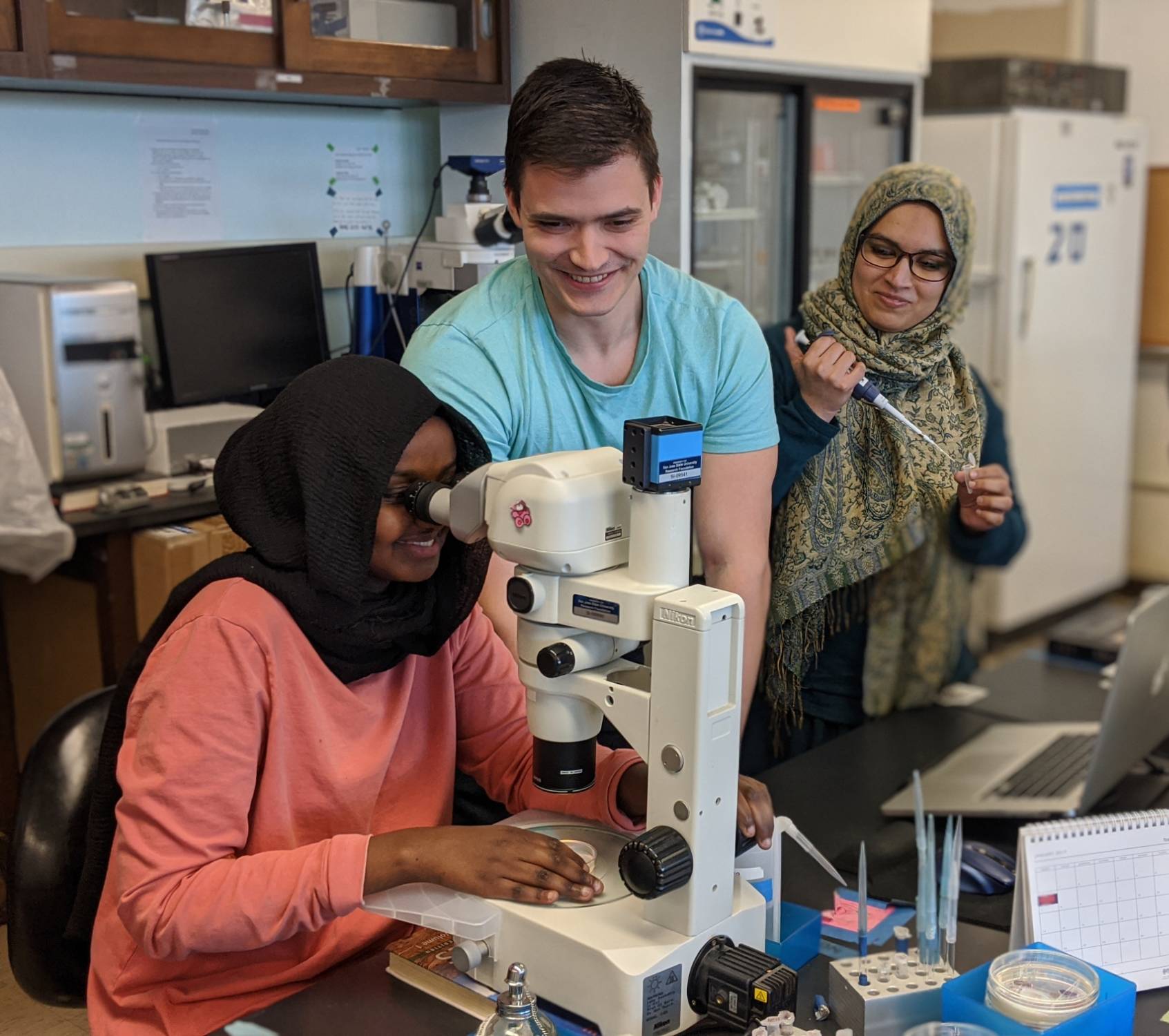
Student research activities in the College of Science are central to the San Jose State University mission in three ways:
- Research expands the base of human knowledge,
- Engagement in research is a pathway to student success, and
- Research activity weaves the scholarly tapestry that enriches the lives of every member of the university community.
How do I join a research group?
If you would like to join a research group, here are three simple steps to take:
1. Look through the websites of the faculty-led research groups and choose two or three that interest you. The links for research groups in each department are below! Most faculty accept research students year-round, whenever there is a good fit.
Research groups in each department:
- Biological Sciences
- Chemistry
- Computer Science
- Geology
- Mathematics and Statistics
- Meteorology and Climate Science
- Marine Science and MLML
- Physics and Astronomy
- Science Education
2. Email the professors who lead the two to three research groups that interest you and request an appointment to talk about research. It is helpful if you tell the professor your current year (i.e. first-year, second-year, etc.), your major and concentration, and any coursework that might prepare you for this research training experience.
3. Meet with the professors, and ask what your project would be and how much time commitment is required. This is also a great opportunity to see first-hand what each professor’s mentoring style is like and if it is a good fit for you.
When you find a research mentor that is a good fit and they offer you a research training experience, accept their offer! Usually, you should enroll in at least one unit of a 180 course (undergraduate research) each semester that you participate with the faculty research mentor. These 180 units can count toward elective units in many majors. Have fun! This may well prove to be one of the most transformational experiences in your career.
Also, check out these student research support programs to see if you qualify for any of these federally-funded programs directed by SJSU faculty that could provide you with financial support.
Frequently Asked Questions
Why undergraduates students should get research training
In the sciences, it is widely understood that graduate students should engage in research training with faculty mentors to integrate the knowledge and skills they have learned in traditional courses and to more deeply engage in the scientific process. Becoming a scientific researcher, teacher or medical professional requires the ability to integrate a wide array of technical skills and basic knowledge. However, we in the SJSU College of Science have also found that undergraduate students greatly benefit from learning how to integrate scientific information and skills to solve complex, open-ended problems in real world science through undergraduate research training.
In the College of Science at SJSU, we strongly encourage undergraduate students to gain research training. Engaging in student research experiences with personalized mentoring by caring, knowledgeable, and dedicated faculty members is a highly effective way for undergraduates to both reinforce their knowledge and develop their advanced problem solving skills.
Benefits of undergraduate research training for SJSU students
Many studies have now confirmed that a number of benefits accrue to students that participate in UG research training:
- Gains in knowledge and skills, including enhanced content mastery, creative thinking, problem solving skills, technical skills, and communication skills.
- Academic achievement and educational attainment, including higher retention rates, grades, persistence in the major, graduation rates, and admission to graduate and professional schools.
- Professional growth, including enhanced ability to work in teams, strengthening of professional networks, and enhanced professional credentials.
- Personal growth, including enhanced ability to learn independently, stimulation of curiosity, increased confidence, and enhanced development of personal initiative.
Furthermore, the benefits are especially profound for students from underrepresented groups where engagement in research correlates positively with virtually all student success outcomes. This is critical at SJSU where more than one quarter of students identify as first generation college students and over a third identify as groups that are underrepresented in the sciences.
Benefits of undergraduate research training to SJSU
While the significant benefits of undergraduate research training for students provide ample justification on their own, there are numerous additional benefits to the university and community as well. Beyond the obvious benefit of any research enterprise of generating new knowledge that benefits society, supporting UG research experiences also strongly benefits the institution. Faculty cite involvement of undergraduate students in their research as a highly desirable part of their jobs because:
- Training undergraduates can help them achieve their scholarly outcomes.
- It helps break down barriers between faculty and students.
- It informs their teaching.
- It increases their job satisfaction.
Therefore, maintaining a vigorous undergraduate research training program can be viewed as having benefits for both faculty recruiting and retention. Beyond the benefit to individual faculty, the institution benefits from undergraduate research training by:
- Building a community of scholars.
- Deepening relationships with alumni.
- Providing opportunities to engage the community.
- Enhancing the institution’s reputation.
- Building extramural funding.
How are undergraduate students engaged in research at SJSU?
Undergraduate research training is not uncommon in higher education. Virtually every university that supports research allows undergraduate students to participate in research training opportunities. However, at many research-intensive universities, undergraduate students serve as a low-level assistants, such as dishwashers or simply providing technical support for doctoral or postdoctoral researchers. In the College of Science at SJSU, we have a strong culture of engaging undergraduate students in meaningful research training experiences. Undergraduate research students typically learn to participate in every aspect of the research project, ranging from examining the literature, to experimental design, to conducting the laboratory activities, to analyzing the data, to co-writing the publications. The fact that SJSU undergraduate research students are truly engaged intellectually in the science is corroborated by the fact that undergraduate students are frequent co-authors with faculty on research publications.
Naturally, undergraduate students are not ready immediately to perform the various research functions independently, so they are trained by their faculty mentors and more senior members of the research groups. It is precisely this intellectual engagement that leads to many of the benefits of undergraduate research training to both faculty member and student. In the CoS at SJSU, enthusiasm for this type of undergraduate student training is one of the key attributes that we seek in our faculty and this priority among our faculty starkly distinguishes SJSU faculty from many faculty members at research-intensive institutions where dedicating time for mentoring of individual undergraduates is not considered a high priority.
Because of the many benefits, the College of Science strongly encourages undergraduate research training. Indeed financial support for undergraduate research training is provided at all levels of the university, including grants to support student stipends and research costs, assigned time for faculty mentoring student researchers, “just-in-time” funds for addressing unexpected research needs and opportunities, and recognition of student research accomplishments at the annual College of Science Student Research Day where our students present posters describing their research projects each spring.